


You’ve built your small business from the ground up. You’ve weathered the slow months, figured out your margins, and finally built a loyal customer base. But now you’ve hit a ceiling. Maybe you need a bigger retail space, maybe you need to buy three new work trucks to fulfill contracts, or maybe you just need to hire a general manager so you can finally take a weekend off.
Inevitably, the question pops up: Is it time to take out a business loan or look for outside investors?
It’s easy to get caught up in the hype of raising capital. But for a traditional small business—whether you run an HVAC company, a boutique bakery, or a local marketing agency—debt and equity are serious commitments, not trophies. Here is a practical, ground-level look at how to decide if your company actually needs financial funding, and how to figure out exactly how much to ask for.
1. The "Good" vs. "Bad" Reasons to Seek Capital
Not all funding needs are created equal. Taking on debt to cover up a broken business model is a recipe for disaster. Taking on debt to pour gas on a fire that’s already burning is just smart business.
Good Reasons to Get Funding:
Asset Purchases with Direct ROI: Buying a piece of heavy machinery that allows you to take on larger, more profitable jobs immediately.
Bridging Predictable Seasonality: Securing a line of credit to buy inventory ahead of your busy season, knowing the cash will flow back in 90 days.
Expansion: Opening a second location after your first one has been highly profitable and systematized for at least a year.
Fulfilling Major Contracts: You just landed a massive B2B account, but you need to hire two extra people to service it before the client's first invoice gets paid.
Bad Reasons to Get Funding:
Covering Unexplained Losses: If your core operations are bleeding cash and you don't know exactly why, a loan will only delay the inevitable.
"Marketing" with No Strategy: Throwing borrowed money at vague advertising campaigns hoping it brings in customers.
Owner Lifestyle Inflation: Pulling capital out of the business to fund a personal lifestyle upgrade.
2. Do the Math: Finding Your Actual Gap
Before you walk into a bank or pitch a local partner, you need to know exactly what your shortfall is. This is known as your External Financing Needed (EFN).
Many small business owners guess this number. They think, "I probably need about $100k to expand." That's a dangerous game. You need to calculate the actual cost of your next growth phase, subtract the cash your business will naturally generate during that time, and find the true gap.
Use this to estimate your actual funding shortfall:
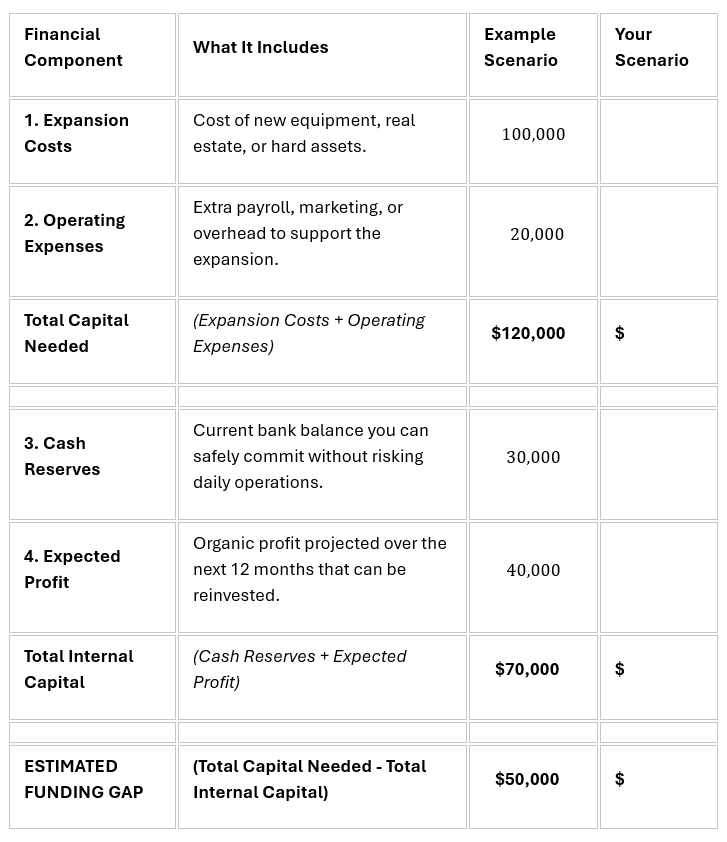
Funding Gap Calculation
How to read the result:
If the final number is positive: This is your funding gap. You need to seek outside capital (like a loan or investor) for this specific amount to safely execute your expansion.
If the final number is zero or negative: You have a surplus. Your business generates enough internal cash to fund its own growth without taking on outside debt or giving up equity.
Key Takeaway: Only ask for what fills your specific gap, plus a small contingency buffer. Over-borrowing leaves you paying interest on cash you don't need, while under-borrowing forces you right back to the bank in six months.
3. The Pecking Order of Small Business Finance
If your calculator result showed a big red number, you have a funding gap. Now, where do you get the money?
In corporate finance, there is a concept called the "Pecking Order Theory." It suggests that businesses should prioritize their financing sources based on the path of least resistance and lowest risk.
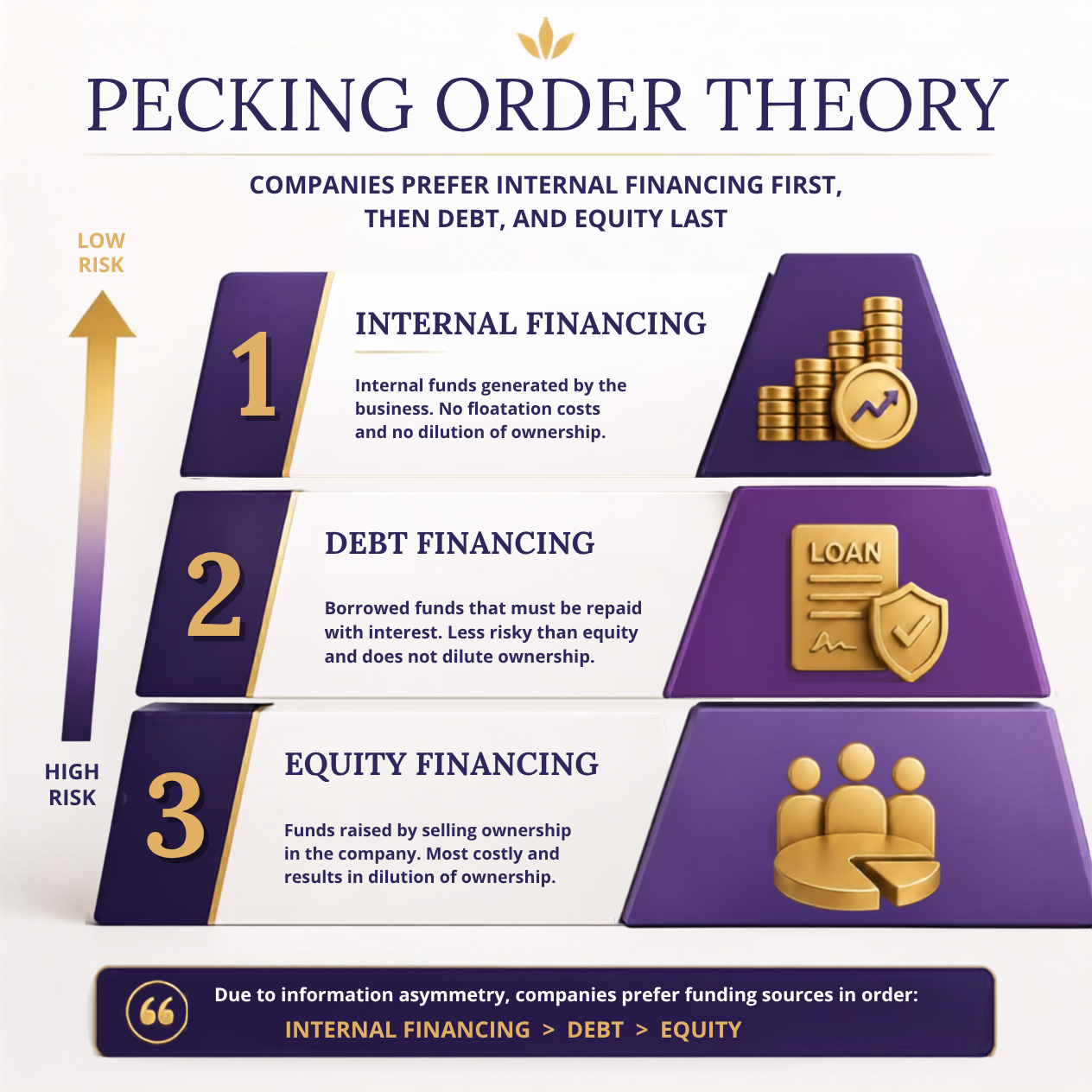
The Pecking Order Theory of Financing
Step 1: Internal Financing (Bootstrapping)
Before looking outward, look inward. Can you optimize your cash flow? Can you negotiate longer payment terms with your suppliers (Net-60 instead of Net-30)? Can you require larger upfront deposits from your customers? Often, you can "fund" your own growth simply by tightening up your operational efficiency.
Step 2: Debt Financing (Loans & Lines of Credit)
If internal funds aren't enough, debt is usually the next best step for a stable small business.
Pros: You retain 100% ownership and control of your company. Once the loan is paid off, the obligation ends. The interest is also tax-deductible.
Cons: You have a strict monthly payment that you must make, regardless of whether you had a good sales month or a terrible one.
Options: SBA loans (like the 7(a) program), local credit union term loans, or revolving business lines of credit.
Step 3: Equity Financing (Investors/Partners)
Selling a percentage of your business to a local investor or partner is the final tier.
Pros: There are no mandatory monthly payments. If the expansion fails, you don't legally "owe" them the money back the way you owe a bank.
Cons: You are giving up a permanent slice of your future profits. You also lose total autonomy—your new partner will get a say in how the business is run. For a traditional Main Street business, equity is often the most expensive money you can take in the long run.
The Bottom Line
A healthy business doesn't fear funding; it uses it strategically. If you have a proven model, clear demand that you can't currently fulfill, and a mathematical gap between your cash reserves and your expansion costs, it is absolutely time to explore your funding options.
Just make sure you're funding the solution to a growth bottleneck, not putting a band-aid on a leaky bucket.