

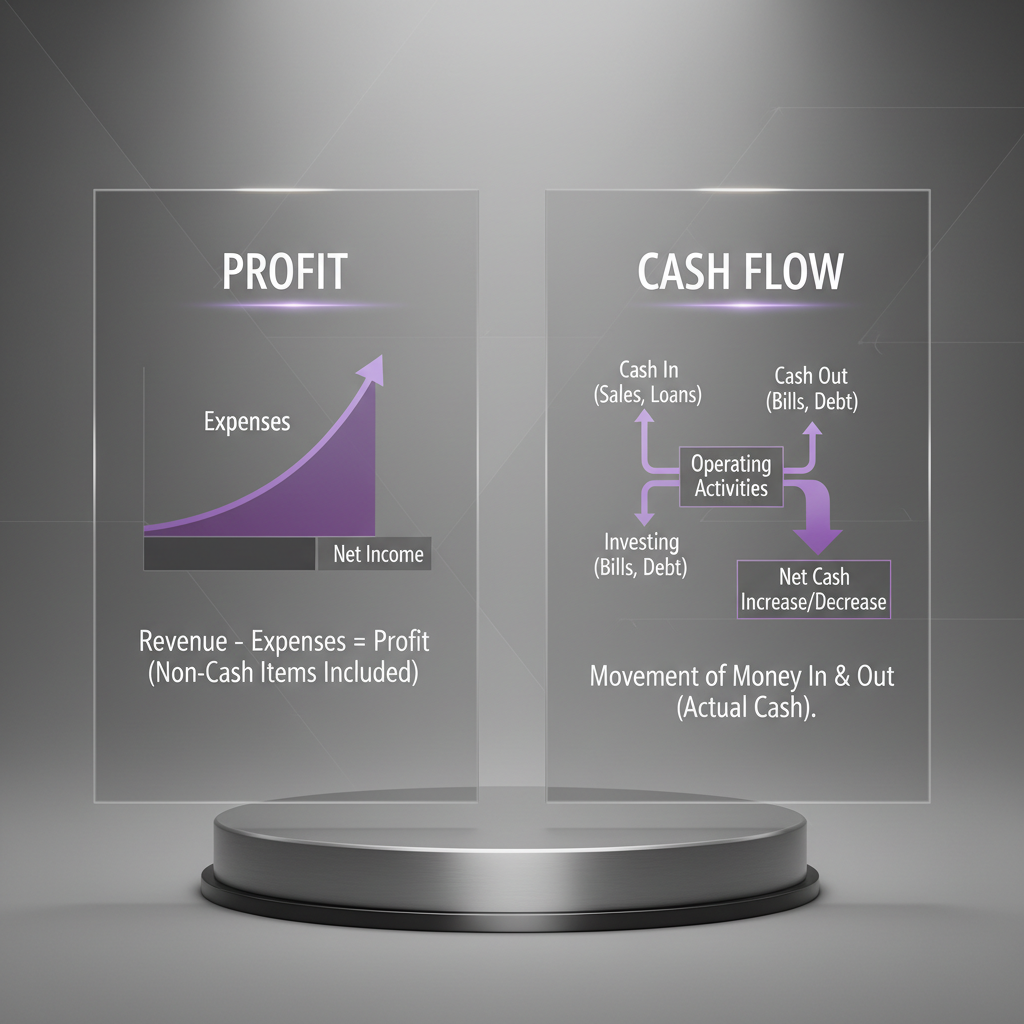
A Small Business Owner's Guide to Cash Flow
It is a terrifying and all-too-common moment for business owners: Your CPA hands you a Profit and Loss (P&L) report showing a fantastic quarter. You’re profitable! But when you check your bank account to run payroll the next day, the balance is practically zero.
How can a business make money on paper but be completely broke in reality?
If you are experiencing this confusion and anxiety, you are not alone. Let's break down exactly why this happens and how you can fix it.
Profit vs. Cash Flow: The Water Tank Analogy
To understand profit vs cash flow, it helps to think of your business as a rainwater collection system.
Profit is the rain falling on your roof. It’s the total amount of water your system has "earned" during a storm. Your P&L report measures this rainfall.
Cash Flow, on the other hand, is the actual water sitting at the bottom of your collection tank, ready for you to drink.
Even if it’s pouring rain (high profit), if the water is getting stuck in the gutters, trapped in a separate barrel, or secretly leaking out of the pipes, your main tank stays empty. You can’t drink "rain on the roof"—you can only drink the water in the tank. If your business runs out of water in the tank, it dies of thirst, regardless of how much it rained.
The Culprits: Where Is Your Cash Going?
If your business is profitable but your bank account is empty, your cash is almost certainly trapped in one of these three places:
Unpaid Invoices (Accounts Receivable): This is the water stuck in the gutters. You did the work, you billed the client, and your accountant recorded the profit. But if the client takes 60 days to pay you, that profit hasn't turned into cash yet.
Upfront Inventory Costs: This is water trapped in a separate barrel. If you spent $50,000 on inventory that is sitting in a warehouse, that cash is gone. On paper, it’s just an asset transfer, so it doesn't immediately hurt your profit margins. But in reality, it drains your bank account.
Owner Draws and Debt Payments: When you take money out of the business to pay yourself or to pay down the principal on a business loan, it reduces your cash balance. However, these movements don't always show up as standard expenses on a P&L, making your profit look artificially higher than your available cash.
3 Practical Ways to Improve Business Cash Flow Immediately
You don't have to just wait and hope the money shows up. If you need to improve business cash flow, start with these three strategies:
Shorten Your Invoice Terms: Stop acting as a free bank for your clients. If you currently use Net 60 terms, switch to Net 30. If you use Net 30, switch to "Due on Receipt" or require a 50% deposit upfront before work begins.
Offer Early Payment Discounts: Incentivize clients to fill your water tank faster. Offer a "2/10 Net 30" discount—meaning they get 2% off their total bill if they pay within 10 days; otherwise, the full amount is due in 30 days.
Manage Inventory Leanly: Stop tying up all your cash in boxes sitting on shelves. Shift toward "just-in-time" inventory if possible, and aggressively liquidate dead stock that isn't moving, even if it means selling it at a slight loss to get some cash back into the business.
Stop Reacting, Start Predicting: The Cash Flow Statement
While a P&L tells you what happened in the past, a Cash Flow Statement acts like a radar, telling you what's happening right now.
Better yet, maintaining a cash flow forecast allows you to see weeks or months into the future. It warns you when a cash crunch is coming before it happens, giving you time to follow up on late invoices, delay an equipment purchase, or tap into a line of credit without panic. If you are looking for solid cash flow management Texas businesses trust, getting a grip on this specific report is step one.
Expert bookkeeping services Fort Worth and beyond don't just hand you a tax return; they help you read the radar.
Stop guessing and start knowing.
We can help you build a cash flow forecast to give you peace of mind and ensure you always make payroll. Let’s talk. Schedule your free Discovery Call today